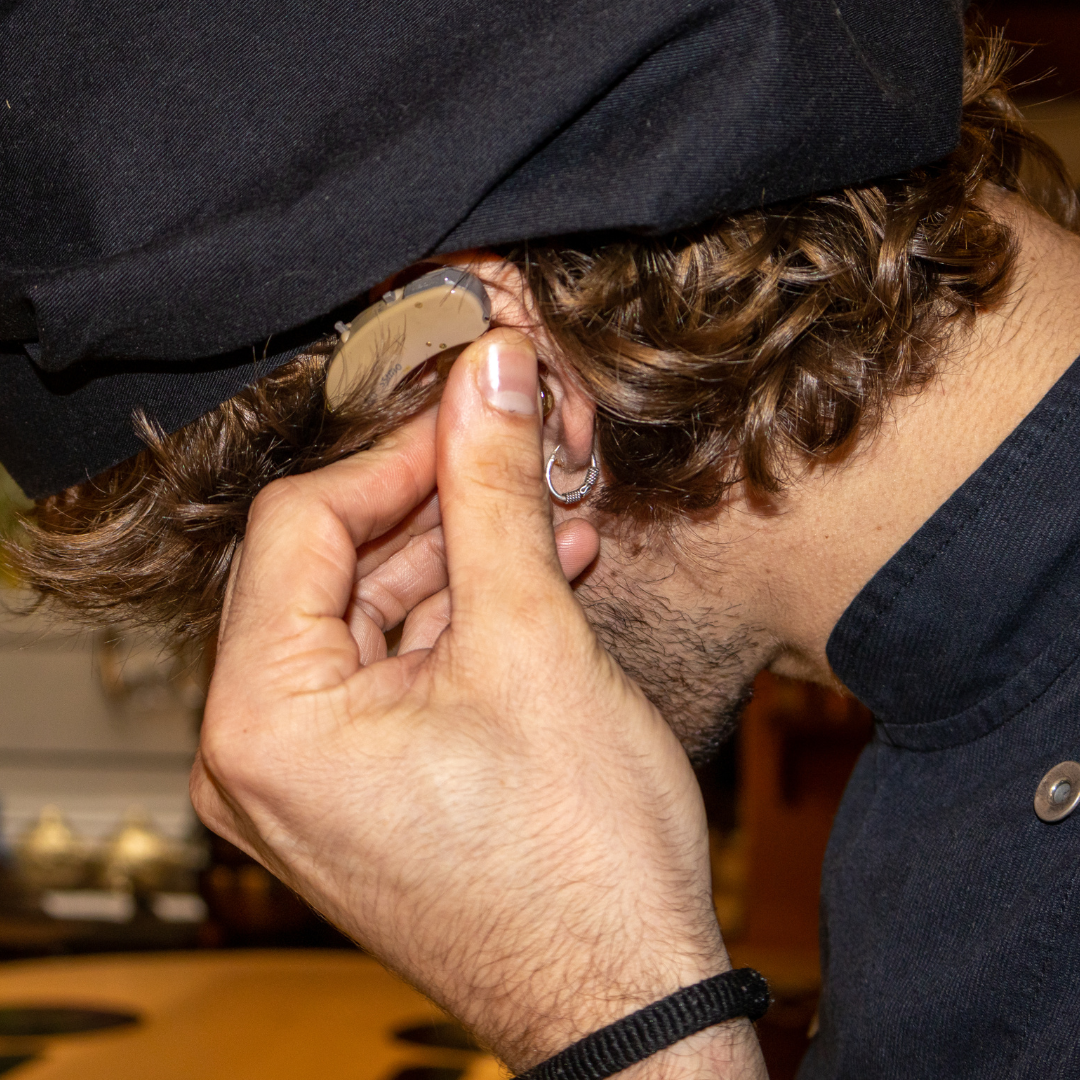
Restaurant conversations can be difficult to follow when environmental noise competes with your focus and hearing. Our specialists can evaluate hearing under both calm and noisy listening conditions to establish why noisy rooms present such difficulty. After diagnosing the source of your difficult hearing, we design targeted interventions tailored to your listening needs.
Explaining Normal Quiet Hearing Versus Restaurant Listening Fatigue
Quiet rooms provide a favorable signal-to-noise ratio, meaning a speaker’s voice is much clearer than the sounds around it. Commercial restaurant spaces present the polar opposite acoustic dynamic. Multiple voices, music, kitchen noise, and reverberation overlap with speech, forcing the ears and brain to work harder to separate the person you want to hear.
These communication barriers frequently indicate high-frequency hearing loss, central auditory-processing disorders, or age-related sensorineural changes. Attention, fatigue, dim lighting, and distance from the speaker may make it worse. It is common to display normal baseline audibility on conventional hearing tests while failing comprehensive speech-in-noise testing. Difficulty in restaurants deserves evaluation even when everyday hearing seems normal.
How Is High-Frequency Hearing Loss Diagnosed?
We initiate evaluation by exploring challenging acoustic environments, acoustic trauma history, subjective tinnitus, prescription drug profiles, and unilateral ear changes.
Standard pure-tone audiometry gauges the lowest volume thresholds detectable across varying acoustic frequencies via specialized earphones and bone oscillators. High-frequency hearing loss commonly presents on the audiogram as a characteristic precipitous drop in the higher frequency ranges. Additional testing may include tympanometry to assess middle-ear function and word-recognition testing to measure speech understanding.
Standard quiet test booths fail to simulate real-world restaurant noise, making speech-in-noise testing a crucial clinical tool. This diagnostic protocol measures your capacity to understand target words or sentences against progressively louder multi-talker babble. In combination, these diagnostic metrics reveal whether communication hurdles involve audibility thresholds, speech discrimination, neural noise management, or mixed conditions.
How Auditory Processing Difficulties Impact Adult Hearing
An auditory processing disorder affects how the central auditory nervous system interprets sound. The peripheral auditory system may register sounds within normal limits, yet the brain falters when separating competing acoustic inputs, sorting speech sounds, or tracking fast speech. We systematically verify peripheral hearing health before establishing whether an advanced auditory-processing evaluation or medical referral serves your needs.
Behavioral Strategies for Hearing Clearly in Loud Venues
Small, intentional adaptations can optimize the clarity of speech reaching your ears and leverage helpful visual speech cues. Prior to dining, choose venues known for lower noise levels or schedule meals during quieter dining hours. Facilities equipped with upholstered booths, acoustic baffles, fabric curtains, carpeted floors, and soft materials prove far easier on hearing than minimalist, hard-tiled spaces.
Upon entering the restaurant:
- Request a table away from the kitchen, bar, speakers, and large groups.
- Choose a seat with your back against a solid wall to block acoustic clutter originating from behind.
- Position yourself to directly face companions under bright lighting to enhance facial comprehension.
- Minimize the physical gap separating you and the person speaking as much as reasonably possible.
- Position your better-hearing ear directly toward your main conversational partner.
- Ask the speaker to rephrase the missed portion instead of repeating everything.
- Validate significant pieces of information directly rather than feigning understanding during dialogue.
- Step away for a brief auditory rest when cognitive listening fatigue begins to set in.
- Invite companions to focus on clear articulation and a measured, comfortable cadence.
- Speaking with excessive volume creates acoustic distortion that fails to make words clearer.
Assistive Hearing Tools and Technology for Complex Acoustic Environments
Selecting the ideal assistive technology depends upon underlying diagnosis, specific acoustic challenges, and verified hearing loss. Professionally programmed hearing aids incorporate multi-channel directional microphones, digital noise reduction algorithms, and custom restaurant settings to capture frontal speech while attenuating background interference. Users should establish realistic expectations because no hearing device can fully eradicate all unwanted ambient speech.
Utilizing an external remote microphone can deliver a dramatically superior signal-to-noise ratio. Worn on the speaker’s collar or set on the table, the microphone broadcasts direct audio to paired hearing aids or specialized receivers. This strategy bypasses the detrimental effects of room reverberation, distance, and localized background chatter.
Other useful options include:
- Wireless conference table microphones that capture multi-speaker discussions
- Telecoils or hearing-loop systems in equipped venues
- Mobile speech-to-text applications delivering instant visual captions during dinner
- Modern wireless hearables delivering directional beamforming and sound enhancement
- Sound-level meter applications and community-driven quiet dining guides
We will help compare available technology, verify device compatibility, and instruct you on utilizing your selected hearing equipment.
How an Audiologist or Physician Can Improve Hearing in Noise
A thorough audiological evaluation expands the diagnostic scope well past simple quiet listening performance. Our clinicians review the specific environments, vocal pitches, and decibel levels that trigger breakdowns to design a personalized test protocol. The assessment may include pure-tone thresholds, middle-ear testing, word recognition, and speech-in-noise measures. Dedicated central auditory-processing testing will be scheduled if your history and primary diagnostic testing indicate central pathway issues.
Rapidly progressing, asymmetrical, or sudden hearing decline warrants an urgent clinical referral to an ear, nose, and throat physician. Dedicated individualized care pinpoints the underlying auditory cause rather than dismissing your struggles as standard restaurant noise.
Request an Audiology and Hearing Evaluation Today
If struggling through dinner conversation leaves you mentally exhausted, detached, or constantly guessing, schedule a complete hearing evaluation with our clinic. We can evaluate targeted solutions to optimize your hearing in noisy environments using prescription hearing aids, assistive listening technology, or communication strategies tailored to you.
Connect with us today to arrange your clinical visit and take the first step toward clearer, easier dining communication.